
One-piece dental implants probably are not something you have spent much time thinking about. The term usually enters your vocabulary only when you start exploring ways to replace missing teeth. When you picture your new teeth, your mind may go straight to your smile, the foods you want to eat, or finally keeping a denture in place. But how far ahead does that picture extend? Have you considered how the foundation beneath those teeth may perform in five years?
Researchers have examined that same long-term question. In a recent systematic review, one-piece implants had a 96.79% survival rate after five years. At Aesthetic Associates Centre in Buffalo, NY, we use one-piece mini dental implants to support crowns, bridges, and dentures. Their construction can influence how we place them, when we attach the replacement teeth, and how they support those teeth in the years ahead. But how can the same implant be both “one-piece” and “mini”?
Are One-Piece Dental Implants the Same as Mini Dental Implants?
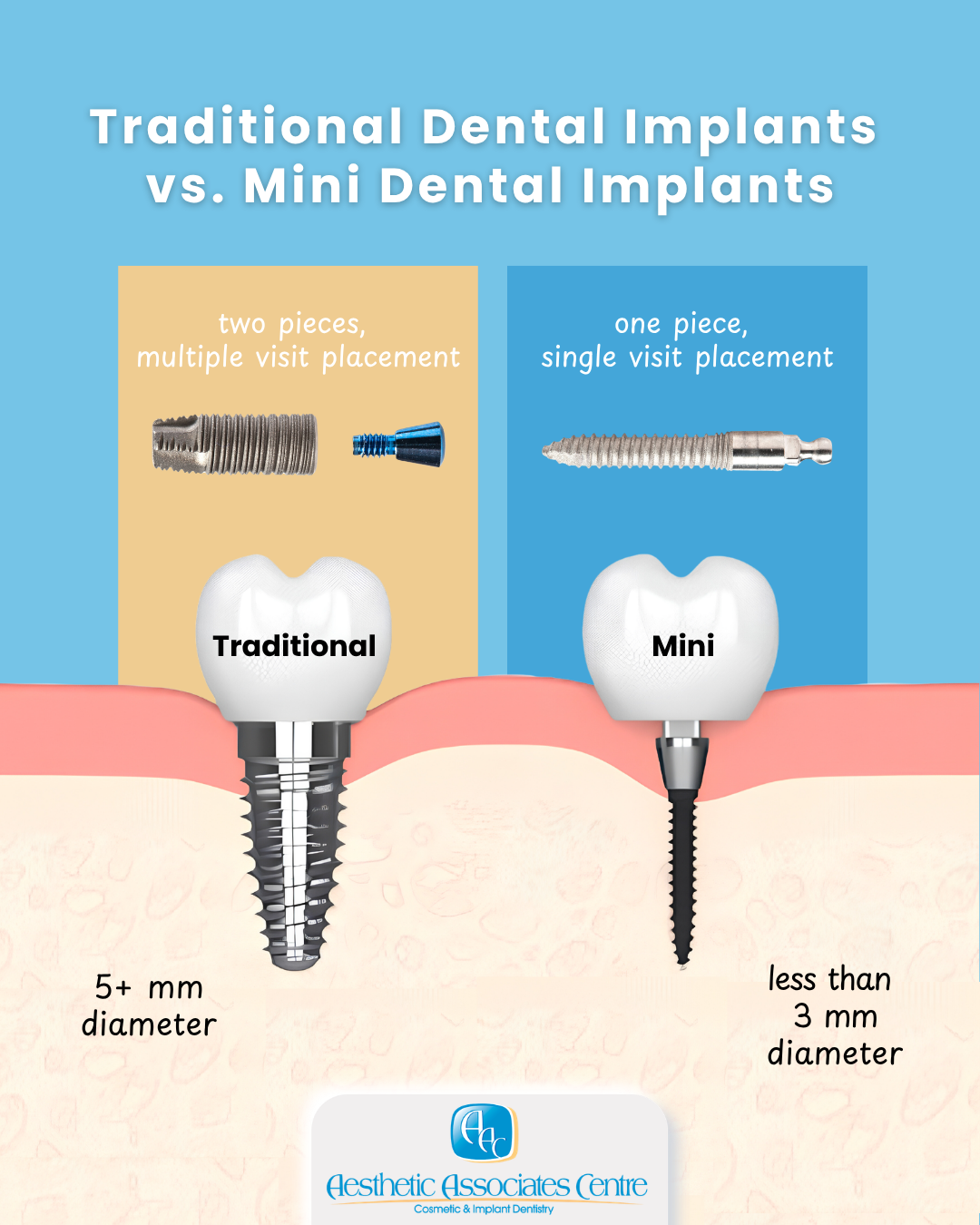
Not exactly, but a dental implant can be both. It is similar to the difference between an electric vehicle and an SUV. One term describes how the vehicle is powered, while the other describes its size and shape. A vehicle can fit both categories, but the categories do not mean the same thing.
A dental implant can fit more than one description, too. “Mini” describes the implant’s width. Mini dental implants measure less than 3 millimeters in diameter. “One-piece” describes how the implant is constructed. The portion placed in the jawbone and the abutment that supports the replacement tooth are manufactured as one continuous unit.
The mini dental implants we place fit both categories. Their narrow diameter makes them mini implants, while their unified construction makes them one-piece implants. However, some one-piece implants have a wider diameter. Calling an implant “one-piece” tells you how it is built, not how wide it is.
Understanding the Three Parts of a Dental Implant
A dental implant restoration has three main parts: the implant body, the abutment, and the replacement tooth.
The implant body serves as an artificial tooth root and supports the restoration above it.
The abutment is the connector between the implant body and the replacement tooth. It extends above the gums, providing the restoration with a secure attachment. The restoration is the visible replacement tooth or teeth. Depending on the treatment, the restoration may be a crown, bridge, or denture.
| Component | Location | Function |
|---|---|---|
| Implant post | Inside the jawbone | Creates the foundation |
| Abutment | Between the implant post and restoration | Connects the restoration to the implant |
| Restoration | Above the gums | Replaces the visible tooth or teeth |
On a one-piece implant, the portion anchored in the bone continues above the gums to create the abutment. The restoration remains separate and attaches to the abutment above the gums.
A two-piece implant separates the implant body and abutment. The implant body anchors in the jawbone, while the separate abutment connects the implant to the restoration. In either design, the final restoration remains a separate component that we attach to the abutment.
Can One-Piece Dental Implants Simplify the Treatment Process?
An implant’s construction can influence how many steps occur between placement and the new teeth. With a two-piece system, the dentist places the implant body and attaches a separate abutment either during the same appointment or at a later stage. The timing depends on the treatment plan.
A one-piece implant arrives with the abutment already built in. When we place the implant, the connection for the restoration is immediately available above the gums. There is no separate abutment to attach later, removing one component and a potential step from the process.
When the implant has enough stability, we may be able to attach a temporary crown, bridge, or denture soon after placement.
The terms “mini” and “one-piece” provide useful details, but they cannot capture the full treatment experience. The complete plan accounts for the implant’s size and construction, the teeth it will support, and the time the mouth needs before the final restoration is ready.
Which Implant Option Fits Your Smile?
Are you replacing one tooth, securing a loose denture, or rebuilding a full arch? Your answer gives terms like “mini” and “one-piece” a practical purpose. It helps determine how many implants you may need, what they will support, and how your treatment may unfold.
Bring that question to Aesthetic Associates Centre in Buffalo, NY. We will look at the teeth you need to replace, explain the options that fit your situation, and show you how one-piece mini dental implants could work within your treatment plan. Contact our office to book a free consultation.
