
Many people are surprised to learn that there are different types of dental implants. Unless you have started looking into tooth replacement, it is probably not something you have had a reason to think about. In the same way, different shoes are designed for different needs, such as support, comfort, stability, or added height, dental implants don’t all come in the same form. Your jawbone, oral health, and treatment goals all help determine which implant design makes the most sense.
At Aesthetic Associates Centre in Buffalo, we provide implant options that make treatment possible for more people. Mini dental implants are smaller than traditional implants and can often be placed through a more conservative procedure. We can use them to replace a single tooth or even restore a full arch of teeth. That range gives us more flexibility to find an option that works with your oral health and the type of tooth replacement you need.
What Are the Different Types of Dental Implants?
The easiest way to separate dental implants is by size. Most fall into one of two categories: traditional implants and mini dental implants.
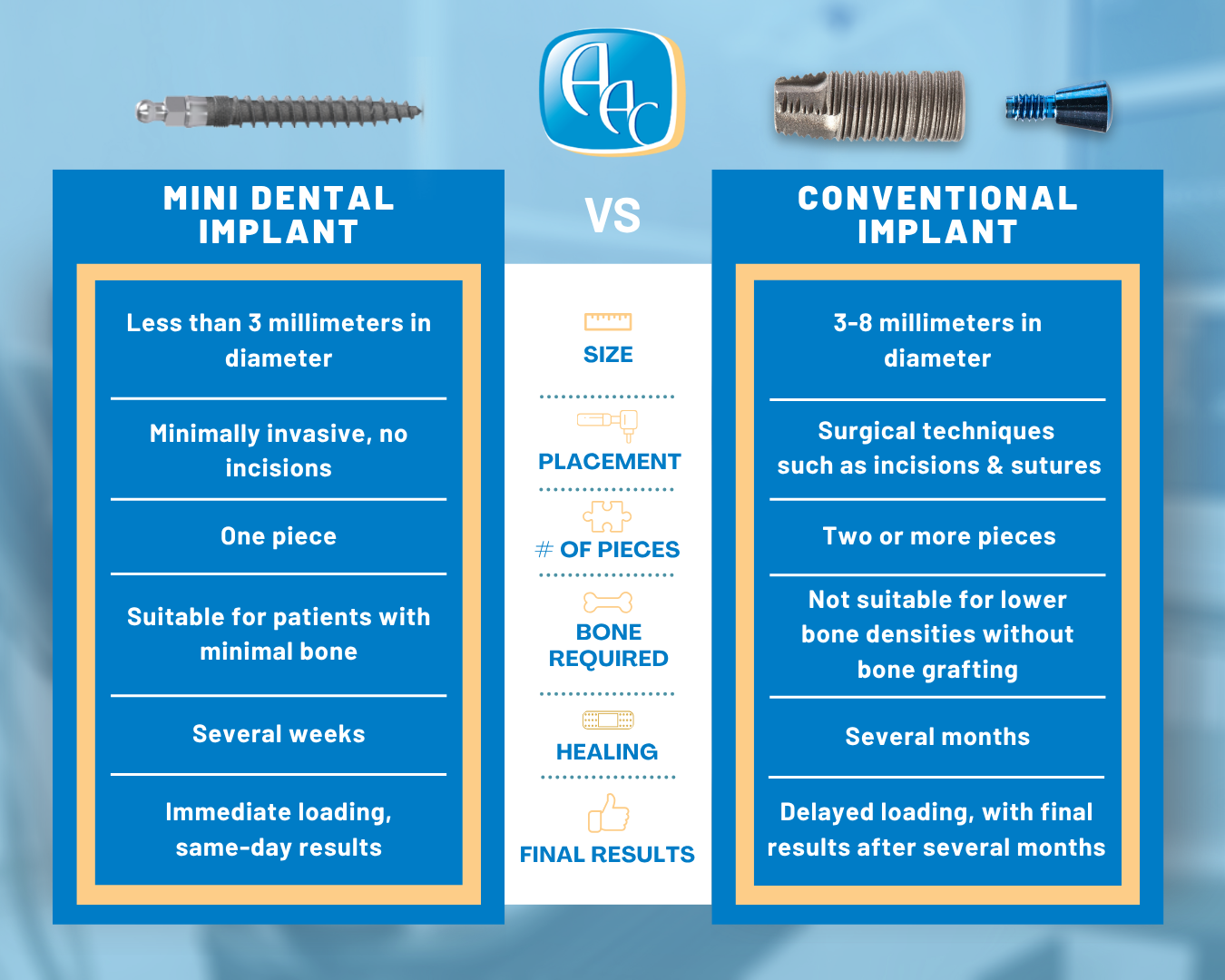
Traditional dental implants average about 5 millimeters in diameter. They are the standard-sized implants many people are familiar with and can replace a single tooth, support a bridge, or hold a complete upper or lower restoration. Since they are wider, they need enough bone height and width for support.
Mini dental implants are less than 3 millimeters wide. They are around half the size of a traditional implant.
The narrower design of a mini implant often provides an alternative option when there is not enough room or bone to accommodate a wider implant. We can still use them to replace a single tooth, support a bridge, secure a denture, or hold a complete upper or lower restoration.
Which Types of Dental Implants Require Less Surgery?
More often than not, mini dental implants require less surgery.
To place a traditional implant, the dentist opens the gum tissue to expose the jawbone, creating enough access to prepare the site and place the wider implant.
Although the procedure is effective, the additional tissue manipulation can place more strain on the body during recovery.
A more extensive procedure may lead to:
- More soreness, swelling, and bruising after placement
- A longer initial recovery period
- More time in the dental chair
- Greater physical stress for patients with certain medical concerns
- Added difficulty for patients who feel anxious about dental surgery
Since mini dental implants are roughly half the size of a traditional implant, they often do not require the same amount of surgical access.
We create a small pilot opening through the gum and into the bone before placing the implant. The smaller, streamlined process limits disruption to the surrounding tissue and can make treatment easier for patients who want to avoid a larger procedure.
The Difference Between One-Piece and Two-Piece Implants
Mini dental implants also belong to another category known as one-piece dental implants.
Traditional dental implants are typically made of two separate components. The implant is first placed in the jawbone, and a second piece, called an abutment, is attached later to support the final restoration.
A mini dental implant combines both pieces into a single, solid unit. Since the implant and abutment are already connected, there is no need to attach a separate connector after placement.
One-piece construction works well with the smaller size of mini dental implants. Together, those features allow us to place many mini implants through a minimally invasive procedure with fewer treatment steps.
For many patients, that can mean:
- A shorter, simpler procedure
- Less healing time after placement
- Fewer appointments from start to finish
- Lower treatment costs than many traditional implant procedures
Find Out How Mini Dental Implants Can Restore Your Smile
Limited bone, concerns about surgery, or a loose denture may have made implant treatment seem unrealistic in the past. Mini dental implants require less bone, involve a less invasive placement process, and can support everything from a single replacement tooth to a complete restoration.
At Aesthetic Associates Centre in Buffalo, we use mini dental implants to overcome many of the barriers that prevent people from replacing missing teeth or securing an unstable denture. Schedule your free consultation to find out if mini dental implants are right for you.
