
If your dentist recommends a porcelain onlay, there is usually a reason they are not jumping straight to a filling or a full crown. An onlay can be used when part of a tooth needs more support, but there is still healthy structure worth keeping. One of the biggest clues is the condition of the tooth’s cusps. Cusps are the raised points on the chewing surface of your back teeth. Run your tongue over a molar, and you can feel the peaks and valleys that help you break down food when you chew.
Damage does not always affect those areas evenly. A cavity, crack, or older filling may weaken one cusp while the rest of the tooth remains strong. A porcelain onlay can cover the weakened area and reinforce the cusps that need support while allowing healthy portions of the tooth to remain in place.
When Can a Porcelain Onlay Help Preserve a Tooth?
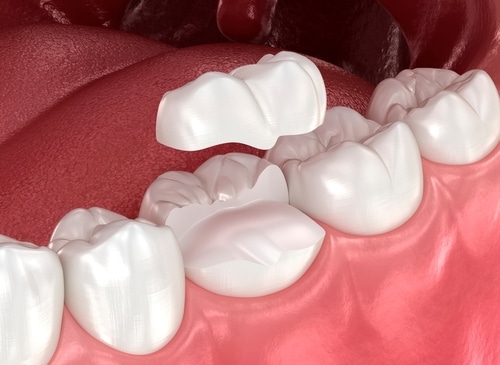
A dental filling works well when the tooth surrounding it is still strong enough to handle normal biting and chewing. For example, if decay is contained within the center of a molar, your dentist can remove the damaged area and fill the space while the surrounding cusps continue to provide support.
As the damaged area becomes larger, the situation can change. Decay may extend closer to a cusp, a crack may weaken one side of the tooth, or a large existing filling may leave only a thin amount of natural tooth around it. Filling the open space repairs the missing portion, but it does not necessarily strengthen a weakened cusp.
Older fillings can create this situation over time. If a large filling cracks, loosens, or develops decay around its edges, your dentist may need to remove both the old filling and additional damaged tooth structure. What remains afterward may need more protection than another filling can provide.
A porcelain onlay can cover a weakened cusp so it has additional support when you bite and chew. At the same time, portions of the tooth that remain healthy and strong can stay in place.
When Can Healthy Tooth Structure Be Preserved?
Keeping as much of your natural tooth as possible probably sounds like an obvious goal. The reason goes a little deeper than simply preferring natural tooth structure over dental work.
Enamel and dentin removed while preparing a tooth do not grow back. Any restoration requires us to remove the damaged or decayed portions first, but different restorations require different amounts of preparation.
A crown, for example, fits over the entire visible portion of the tooth. To make room for it, we have to reshape the tooth around its sides and across the chewing surface.
Preserving tooth structure does not mean keeping every part of a tooth at all costs. A cracked, decayed, or weakened area may need to be removed or covered so the tooth can function properly.
Healthy enamel and dentin are different. When those areas are strong enough to keep doing their job, preserving them allows us to avoid removing sound tooth structure unnecessarily.
A porcelain onlay gives us that flexibility. If a weakened cusp needs coverage, other areas of the tooth may still be healthy. We can restore the portion that needs reinforcement without preparing the entire tooth for a crown.
What Happens When You Get a Porcelain Onlay?
Once we determine that an onlay is the right fit for the tooth, treatment usually takes two visits. During the first appointment, we remove the damaged or decayed areas and prepare the tooth for the restoration. We then take an impression so the onlay can be made to fit the shape of your tooth.
A temporary restoration protects the tooth while the final onlay is being made. At your next visit, we remove the temporary, check the fit and your bite, make any needed adjustments, and bond the porcelain onlay securely in place.
Could a Porcelain Onlay Help You Avoid a Full Crown?
A damaged tooth can tell two stories at once. One area may need reinforcement while the enamel and dentin around it are still doing exactly what they should. At Aesthetic Associates Centre in Buffalo, we assess the damage, biting forces, and healthy tooth structure that remains.
If you have a cracked tooth, a large or failing filling, or a new recommendation for an onlay, contact us to book a free consultation.
