
Your jawbone has depth, your teeth have roots that extend beneath your gums, and important nerves run through areas you can’t see. A traditional dental X-ray captures these structures in a flat image, which can make it hard to determine their exact positions relative to one another. Modern dental imaging gives us a way to explore these structures in much greater detail. So, what is a CBCT scan, and how does it make this possible? CBCT stands for cone-beam computed tomography, an advanced imaging technique that allows us to examine your oral anatomy in three dimensions.
At Aesthetic Associates Centre, Dr. Todd Shatkin and his team use CBCT imaging to plan dental implant treatment with remarkable detail. They can study the jawbone from virtually any angle, measure the space available for an implant, and plan its position before beginning the procedure. Combined with the smaller diameter of mini dental implants, this technology gives the team greater flexibility in planning how to replace missing teeth. The scan takes only a short time, but the information it provides can shape the entire treatment process.
How Does a CBCT Scan Work?
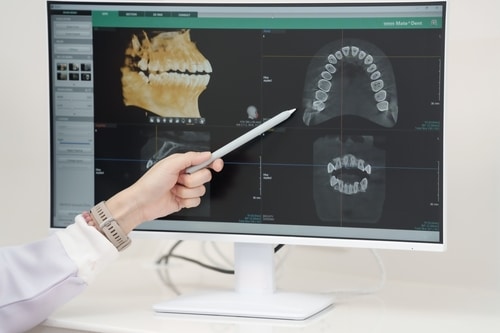
During a CBCT scan, an X-ray source and detector rotate around your head, capturing images from multiple angles. Computer software combines these images into a three-dimensional model that we can explore from different directions, including thin cross-sections of the jaw.
For Dr. Shatkin and his team, these images provide valuable information when planning dental implant placement. We can measure the height and width of your jawbone to select an appropriate implant diameter and length. This is especially useful when planning treatment with mini dental implants, which require less bone width than conventional implants.
The images also help us identify anatomical boundaries that influence implant positioning. In the lower jaw, we can locate the nerve canal and plan how deeply an implant can extend while maintaining appropriate clearance. In the upper jaw, we can evaluate the bone beneath the maxillary sinuses, which may limit implant length or influence whether additional procedures are necessary. We can also examine neighboring tooth roots to plan the implant’s position and angle without interfering with adjacent teeth.
Why Would a Dentist Recommend a CBCT Scan?
Every dental implant needs a secure foundation in the jawbone, but the amount of space available varies throughout your mouth. At Aesthetic Associates Centre, we offer mini dental implants and conventional implants in different sizes to accommodate these differences. A CBCT scan allows us to measure the height, width, and shape of your jawbone so we can choose an implant that fits the available space.
We also need to know exactly where to place it. In the lower jaw, we use the scan to locate the nerve canal and measure how much room we have above it. In the upper jaw, we examine the bone beneath the sinuses. We can also see the roots of neighboring teeth, helping us plan an implant’s angle and depth without interfering with nearby structures.
Replacement teeth also influence our planning. We use implants to support individual crowns, dental bridges, and several types of dentures, including full-arch restorations. Each requires a different arrangement of implants to provide adequate support. CBCT imaging helps us plan implant placement based on available bone and the teeth we intend to replace.
Schedule Your Complimentary Consultation Today
If you’re considering dental implants, understanding the condition of your jawbone is an important part of treatment planning. At Aesthetic Associates Centre in Amherst, NY, we include a complimentary CBCT scan during your free consultation. Dr. Shatkin and our team can use these detailed images to evaluate your bone structure, discuss your tooth replacement options, and explain how we would approach your treatment.
Schedule your free consultation today to explore your dental implant options and see how 3D imaging helps us plan your care.
