
The purpose of full-mouth dental reconstruction is not to fix one isolated problem. We look at the whole mouth to understand how the teeth, gums, bite, and jaw need to work together again.
A strong plan usually comes back to three goals: renew, restore, and replace. We renew areas that need more support. We restore teeth that can still do their job with the right reinforcement. And when a tooth or structure can no longer function the way it should, we replace it with something stronger and more stable.
By the end of treatment, the result is a healthier foundation that supports everyday comfort, chewing, and long-term oral function.
What Is Full-Mouth Dental Reconstruction?
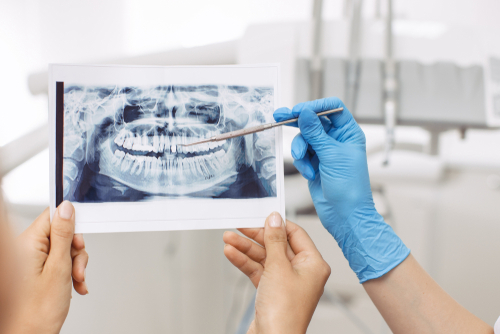
Full mouth dental reconstruction is a coordinated plan for rebuilding oral health when several parts of the mouth need attention at the same time. Treatment usually happens through a series of appointments, with each step planned in a specific sequence.
Many people assume a treatment plan focuses primarily on the teeth. In reality, your teeth are only one part of a much larger system.
Your gums, jawbone, bite, jaw joints, and supporting structures all work together to help your mouth function comfortably and efficiently. When many teeth are worn, damaged, loose, or missing, changes begin to ripple throughout that entire system.
Many patients notice that chewing becomes harder or speech starts to feel less natural. Others feel discomfort because their bite is no longer balanced. Some teeth may be taking on too much pressure, while others are no longer giving the mouth enough support. During full-mouth reconstruction, we address all those concerns together.
What To Expect From Full-Mouth Dental Reconstruction
Stage 1: Assessment and Planning
We begin by talking with you about your goals and taking a close look at your teeth, gums, and bite.
Once we have the information we need, we build a step-by-step plan. We consider healing time, comfort, appearance, and how well your bite will function. This becomes the roadmap for your reconstruction.
Step 2: Strengthening the Foundation
Before we restore teeth, we make sure the supporting structures are healthy. If you need treatment for gum disease, deep cleanings, extractions, or bone grafting, we complete these steps here.
Addressing infections and weak areas early helps prevent future problems. When your gums and bone are stable, everything we build on top has a stronger and more predictable base.
Next, we repair decay, restore broken structures, and prepare teeth for future crowns or bridges.
Stage 3: Completing the Final Restorations
Once we confirm that your bite is stable and your teeth feel comfortable, we place the final crowns, bridges, dental implants, or other restorations.
After placement, we schedule follow-ups to check your bite, answer questions, and make small adjustments. These visits help protect your results and keep your restored smile functioning well over time.
Why We Use Mini Dental Implants for Tooth Replacement
One condition we frequently encounter during full mouth reconstruction is bone loss. Advanced gum disease, missing teeth, and years of wearing loose-fitting dentures can all reduce the amount of bone available to support replacement teeth. Traditional implants require ample bone for support. When sufficient bone is unavailable, patients may need bone grafting before implant treatment can proceed.
At Aesthetic Associates Centre, we use mini dental implants. Mini implants are about half the diameter of traditional implants. Since they are smaller, they can often fit into areas with less available bone. As a result, many patients who may not qualify for traditional implants still have implant options available to them.
We place mini dental implants using Dr. Todd Shatkin’s minimally invasive Shatkin F.I.R.S.T.® technique. We create a small pilot hole and place the implant through this access point. This is called a flapless technique. The technique preserves more of the surrounding bone and tissue. It causes less disruption during placement and often reduces recovery time.
Every patient is different, and some reconstruction cases still require additional procedures. However, mini implant placement often allows us to work with the bone already available, rather than rebuilding bone before treatment can begin.
Let’s Plan a Healthier Foundation for Your Smile
Full-mouth dental reconstruction brings several moving parts into one coordinated plan. If you have questions about your oral health, we can help you understand what needs support, what can be restored, and where replacement may create better long-term stability. With options like mini dental implants, we can rebuild function with a less invasive approach.
Book your free consultation at Aesthetic Associates Centre to learn what full-mouth dental reconstruction could look like for you.
