
A missing front tooth affects one of the most noticeable parts of your smile. Replacing it with a dental implant offers a fixed, natural-looking solution, but the amount of space available for the implant deserves careful consideration. Your front teeth have relatively narrow roots, and the surrounding jawbone may be too thin for a conventional implant. Bone loss following tooth extraction can further limit the available space. Fortunately, a smaller front tooth implant may offer another option without requiring extensive bone grafting. At Aesthetic Associates Centre, our implant team uses mini dental implants to replace certain missing teeth, even in areas with limited bone.
How We Plan Your Front Tooth Implant Placement
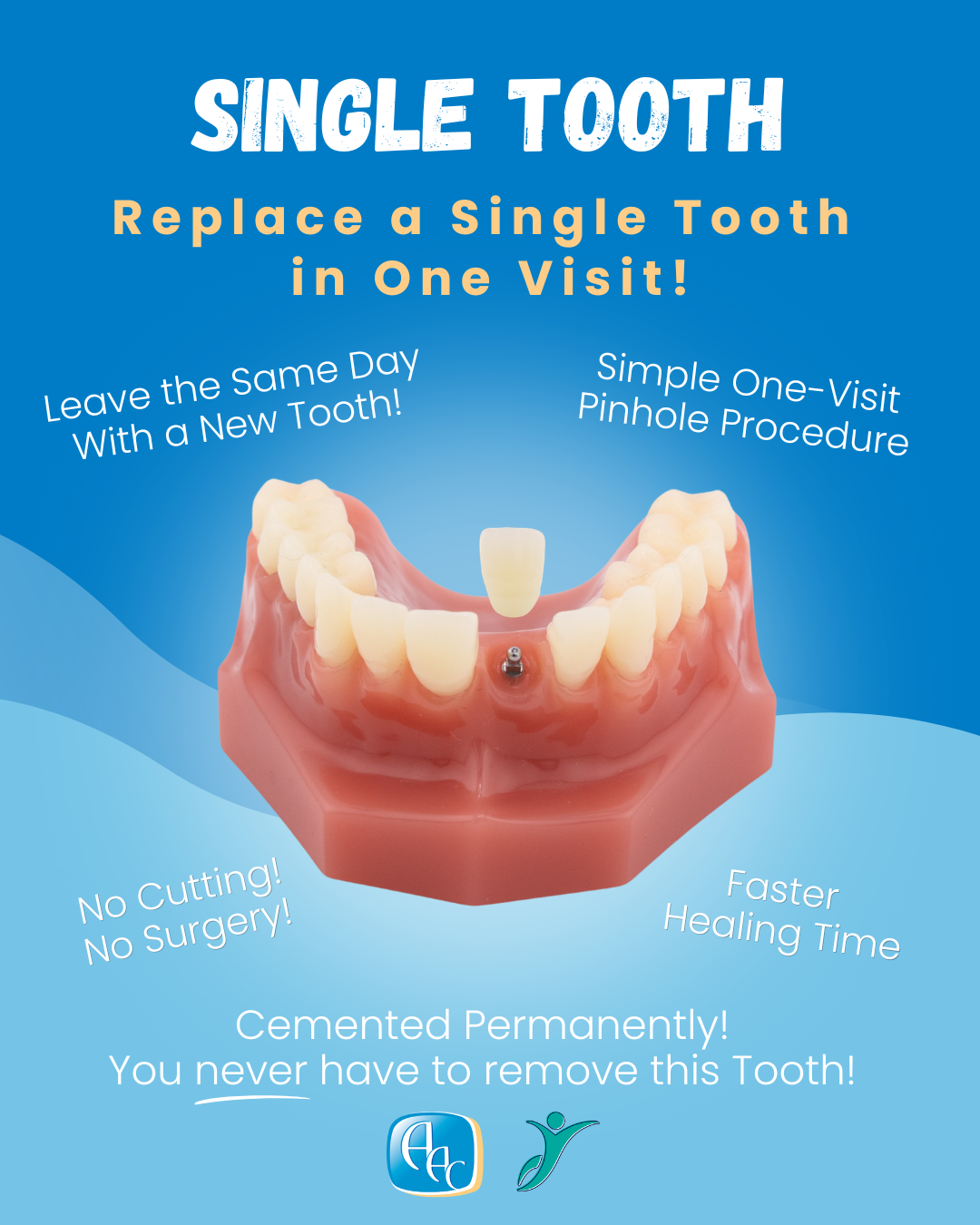
The lower front teeth are among the smallest teeth in your mouth. Their roots are often closely spaced, and the ridge of bone supporting them may be particularly narrow. Both measurements influence where an implant can be placed and how much bone will surround it.
After tooth loss, the jawbone gradually shrinks in the area where the root once provided stimulation. The longer a tooth has been missing, the greater the possibility of changes that affect implant placement, although the amount of bone loss varies.
Our dentists use cone beam computed tomography (CBCT) to examine the treatment area in three dimensions. The scan provides detailed measurements of the bone’s height and width and shows the positions of adjacent tooth roots.
We use this information to select an appropriate implant diameter, identify a suitable placement position, and determine if bone grafting or other preparatory treatment is necessary.
Can You Replace a Front Tooth With a Mini Implant?
Yes. Mini dental implants may be suitable for replacing certain front teeth, including the small teeth at the center of your lower jaw and the upper teeth immediately beside your two front teeth. These areas often have limited space, making placement of a conventional implant more difficult.
Mini implants measure less than 3 millimeters in diameter, compared with approximately 5 millimeters for many conventional implants. Their smaller diameter requires less bone width and provides additional clearance between neighboring roots. Some patients have enough existing bone for a mini implant even when a wider implant would require bone grafting.
Dr. Todd Shatkin helped develop the Shatkin F.I.R.S.T.® technique, a minimally invasive method of placing mini dental implants. Our dentists prepare a narrow channel in the jawbone through a small opening in the gums. In suitable cases, we place the implant without making a larger incision or lifting the gum tissue away from the bone.
Limiting disruption to the surrounding tissue may reduce bleeding, swelling, and discomfort following placement. Many patients also benefit from a shorter recovery period.
Will My Smile Look Natural?
A dental implant supports a custom crown that replaces the visible portion of your missing tooth. For a front tooth, the crown needs to blend with the surrounding teeth in both appearance and function.
We pay close attention to its shape, length, shade, and position. The gumline also affects the final appearance, particularly when replacing an upper front tooth that’s visible when you smile. Existing bone and gum tissue influence the contours we can achieve.
Our dentists coordinate directly with the Shatkin F.I.R.S.T.® dental laboratory to plan your restoration. We consider the appearance of your neighboring teeth, the position of your gums, and how your upper and lower teeth meet when you bite.
Explore Your Tooth Replacement Options Today!
A narrow jawbone doesn’t automatically rule out dental implants. The measurements that make a conventional implant difficult to place may still leave sufficient room for a mini dental implant. At Aesthetic Associates Centre, we’ll evaluate your bone structure, examine the space between neighboring roots, and discuss the type of restoration appropriate for your smile. You’ll have a clearer understanding of your options before making a treatment decision.
Schedule your free consultation to find out if a mini dental implant is suitable for replacing your missing front tooth.
